
Tag Archive for: SEO

Why Winter is a Golden Window for Whistler & Sea-to-Sky Businesses

Winter is the busiest season for tourism, and it’s also the best time to invest in local SEO strategies. Visitors and weekend adventurers flood search engines looking for rentals, restaurants, tours, and services near them. The businesses that show up first capture the most customers.

Google rewards local relevance, distance, and prominence — so having a complete Google Business Profile, active local content, and consistent reviews all help your brand stand out in the Sea-to-Sky local SEO landscape. When your business appears in “near me” searches, you turn online discovery into real bookings.

Geo-Targeting Done Right for Your Location

Using geo-targeting ensures your ads and listings reach the right audience at the right time.

  • Radius and location-group targeting: In Google Ads, focus your targeting on Whistler Village, Creekside, Function Junction, Squamish, and Pemberton. It’s efficient and ensures you’re visible to people already nearby.
  • Localized ad copy: Match your promotions to winter moments, like “Same-day ski rentals 5 min from the gondola.” This connects digital searches to real-world action.
  • Regular updates: Keep your Google Business Profile fresh with current winter hours, storm-day specials, and new offers. That activity tells Google—and visitors—you’re open and responsive.

For businesses seeking Whistler specific digital marketing results that drive real traffic, smart geo-targeting is an essential step.

Seasonal Keyword Optimization: Winter-Specific Search Intent

Search behavior shifts dramatically in the cold months. People type what they need in real time — from “Whistler ski rentals near me” to “best après bar in Function Junction.” Optimizing for seasonal terms like these helps your site capture the influx of winter traffic.

Examples of useful keyword targets:

  • “Whistler ski rentals near me”
  • “Snowshoe tours Sea-to-Sky”
  • “Whistler winter tires”
  • “Creekside après spots”

Updating your blog or landing pages with Sea-to-Sky local SEO phrases ensures your content reflects what visitors are actually searching for this season.

Also, check your technical SEO: keep name, address, and phone number (NAP) consistent, use schema markup, and publish fresh winter-related posts. This helps search engines understand your services and location relevance.

Website Speed and Mobile UX: Crucial for Winter Visitors

Your potential customers are searching while on the move — in hotels, cafés, or gondola lines. That makes website speed and mobile UX critical. A Google-commissioned Deloitte study found that a 0.1-second improvement in mobile speed can boost travel conversions by around 10%. A fast, mobile-friendly site keeps users engaged and more likely to book.

Since Google indexes mobile pages first, your site’s mobile version should load fast and display the same core content as desktop. Compress large images, minimize JavaScript, and focus on the essentials.

For businesses focused on digital marketing excellence, optimizing your site’s Core Web Vitals (page load, interactivity, and stability) isn’t optional—it’s key to higher conversions and stronger rankings.

Your Winter Local SEO Checklist

  • Claim and optimize your Google Business Profile with up-to-date hours, photos, and offers.
  • Add seasonal pages like “Whistler Winter Rentals” or “Sea-to-Sky Snowshoe Tours.”
  • Use local schema and consistent contact info across your site and directories.
  • Set tight geo-targeted ad zones to keep your spend focused.
  • Audit mobile performance — aim for a smooth, 3-tap booking process.

When done well, these steps help your local SEO strategy generate steady leads even on storm days.

About Cloud9 Marketing

Cloud9 Marketing is a full-service creative agency serving Whistler and the Sea-to-Sky Corridor. We specialize in web development, branding, SEO, PPC, and social media management to help local businesses shine year-round. Whether you’re a hotel, tour company, or restaurant, our team crafts Sea-to-Sky local SEO and digital strategies that drive results.

Ready to grow your business this winter?

Book a free consultation with Cloud9 Marketing and discover how our local SEO, web design, and digital marketing strategies can help you stand out in Whistler and the Sea-to-Sky Corridor.

👉 Schedule your free consultation today

Search isn’t just evolving—it’s being redefined.

Artificial intelligence is now at the heart of how people get answers online. Instead of showing a list of links, tools like Google’s Search Generative Experience (SGE), ChatGPT, and Perplexity AI create complete responses to user questions.

If your content isn’t optimized for these tools, it won’t get featured. And that means your audience may never see it.

This is where Generative Engine Optimization (GEO) comes in.

At Cloud9 Marketing, we’re helping businesses across Whistler and the Sea to Sky Corridor get ahead of this shift. Let’s walk through what GEO is, why it matters, and how you can start using it today.

What Is GEO?

GEO stands for Generative Engine Optimization. It’s a new strategy for writing and structuring your content so that AI tools can easily understand and use it.

Instead of focusing only on search engine rankings, GEO is about creating content that’s:

  • Easy for AI to read and process
  • Factually accurate and clearly structured
  • Helpful, trustworthy, and relevant

The goal is to become the source that AI tools rely on when answering questions.

GEO isn’t about quick tricks. It’s about building useful, well-organized content that AI models want to pull from.

How GEO Differs from Traditional SEO

SEO isn’t going away—but it’s no longer enough on its own.

Here’s how GEO builds on traditional SEO strategies and adapts them for today’s AI-powered search environment:

Traditional SEO Generative Engine Optimization (GEO)
Uses keywords to boost rankings Uses questions and answers to offer clarity
Optimizes for humans and search engines Optimizes for AI-generated responses
Focuses on backlinks and authority Focuses on structure and usefulness
Relies on meta tags and schema Relies on scannable, well-formatted content
Aims to appear in search results Aims to be selected as the answer by AI

Put simply: SEO earns visibility in search results, GEO earns placement in AI-generated answers.

Why GEO Should Be a Priority

Search habits are changing. More people are turning to AI-powered tools to get quick, accurate answers—no need to click through multiple links.

Here’s why GEO is becoming essential:

  • AI-powered search is already live. Google, Bing, ChatGPT, and other platforms are using AI to summarize information instantly.
  • AI-generated answers often skip links. If your content isn’t part of the summary, it may never be seen.
  • AI trust builds brand authority. When AI tools pull from your site, it positions you as a trusted expert.
  • Your competitors are catching on. The sooner you optimize for GEO, the more you’ll stand out.

How To Start Using GEO

You don’t need a massive website overhaul. You just need to be strategic. Here are five ways to begin implementing GEO today:

1. Structure your content clearly

Use headings (H1, H2, H3) to organize your pages. Keep paragraphs short and focused on one idea at a time.

2. Provide real value

Write content that answers real questions. Use facts, statistics, and plain-language explanations that help both readers and AI models.

3. Format for readability

Use bullet points, lists, and Q&A-style sections. This makes it easier for AI to scan and understand your content.

4. Add smart internal links

Connect related pages on your site to build topical authority and help AI understand the bigger picture.

5. Use a helpful, natural tone

Write like you’re having a conversation with your audience. Clarity and simplicity outperform jargon every time.

The Future of Search Is Generative

At Cloud9 Marketing, we help businesses create content that performs now—and stays competitive in the future.

GEO isn’t just a buzzword. It’s a practical approach that puts your business in front of your customers, even as search engines evolve.

Whether you’re a tourism operator, a local shop, or a regional brand, now is the time to update your strategy. We’re here to help you do it.

Search is smarter. Your strategy should be too.

Clearing out the clutter? Your digital strategy could use some attention too. As we shake off winter and look ahead to the warmer months, it’s the perfect time to dust off your SEO strategy. Search engine optimization is constantly evolving, and staying ahead of the SEO trends for spring 2025 is crucial for maintaining your visibility and reaching new audiences—especially for small- to mid-sized businesses in competitive regions like Whistler and the Sea to Sky Corridor.

So, what’s blooming in SEO this spring? Let’s dig in.

1. AI & Search: The Rise of Generative Results

Artificial intelligence is continuing to change the way people interact with search engines. Google and Bing are experimenting with generative AI features that summarize information directly in the search results. These AI-generated snapshots often pull answers from multiple sources—meaning the competition for visibility is no longer just about ranking #1.

What this means for your business:
As part of the evolving SEO trends for spring 2025, businesses should focus on high-quality content that demonstrates E-E-A-T—Experience, Expertise, Authoritativeness, and Trustworthiness. Structure your content for both humans and algorithms, and answer common questions in natural, conversational language.

Action tip: Review your existing pages to ensure they’re optimized for long-tail and conversational search queries. Consider adding a clear FAQ section to your most important service pages.

2. Local SEO Is Getting Even More Local

Google is placing more emphasis on hyperlocal search results, especially for users searching on their phones or using Google Maps. This means that when someone searches for a product or service—like “coffee near me” or “bike shop in the area”—Google aims to show results that are not just nearby, but also highly relevant and well-optimized for that specific location.

In the past, simply being close to the searcher might have been enough to appear in local results. Now, Google also considers factors like:

  • How complete and accurate your Google Business Profile is
  • Whether your website content mentions specific neighbourhoods or areas you serve
  • How often your business receives fresh, local reviews
  • Whether your business information is up to date, including hours, services, and photos
  • How well your business is categorized and described

What this means for your business:
Among the top SEO trends for spring 2025 is the push toward hyperlocal relevance. Local SEO now requires more than just proximity—it’s about being recognized as the most relevant and trustworthy option in your area. Make sure your Google Business Profile is complete and up to date. Include local place names in your website content where relevant.

Action tip: Actively collect new customer reviews and regularly update your listings. This signals to Google that your business is active and trustworthy in your community.

For more tips, check out our blog on Understanding Local SEO.

3. Video and Visual Search Are Gaining Ground

With the rise of tools like Google Lens and Pinterest Lens, people are using images to search more than ever. Meanwhile, short-form videos on platforms like Instagram Reels and YouTube Shorts are being indexed and appearing in search results.

What this means for your business:
One of the more noticeable SEO trends for spring 2025 is the growing impact of visual and video content in search. Visual content isn’t just for social media—it can help with SEO too. Optimizing images and videos for search is now essential.

Action tip: Add descriptive alt text to your images, use structured data for your videos, and make sure your media is high-quality and relevant to your services or products.

4. Website Performance Still Matters

Google’s Core Web Vitals continue to play a big role in ranking. If your website loads slowly or isn’t mobile-friendly, your SEO could take a hit—even if your content is great.

What this means for your business:
A fast, mobile-optimized website helps users and boosts rankings. Speed matters more than ever—especially with mobile-first indexing being a priority among SEO trends for spring 2025.

Action tip: Use tools like PageSpeed Insights or GTmetrix to audit your site’s performance. Tackle common issues like large image sizes, unnecessary plugins, or outdated themes. For more guidance, check out our blog on how to optimize your business for mobile.

5. Zero-Click Searches & Snippet Optimization

More people are getting their answers directly from search results—without even clicking through to a website. This means optimizing your content for featured snippets and quick answers is more important than ever.

What this means for your business:
Content that is well-structured and directly answers search queries is more likely to appear in these “zero-click” positions, such as featured snippets or the “People Also Ask” box.

Action tip: Use headers, bullet points, and clear, concise language to make your content snippet-friendly. Focus on answering common customer questions up front. For more ideas on driving visibility in search, check out our blog on 5 ways to increase web traffic in searches.

Final Thoughts: What You Can Do This Quarter

SEO never stands still—but that doesn’t mean you have to feel overwhelmed. This spring, take the time to:

  • Refresh your website content for AI and conversational search.
  • Make sure your local SEO is tight and up to date.
  • Invest in visual content and optimize it properly.
  • Improve site speed and mobile usability.
  • Structure your content for snippets and zero-click searches.

Staying ahead of these trends can help you reach more potential customers—and build long-term digital success.

Need a hand keeping up with SEO trends?

We offer free consultations to help you understand where your business stands and how to improve your online visibility. Let’s talk about your goals and see how Cloud9 Marketing can support your SEO strategy—no pressure, just expert advice tailored to you.

person holding phone - local SEO

Most business owners with a website have heard of SEO—Search Engine Optimization. But in 2025, if your business serves a specific area or has a physical location, there’s one branch of SEO that should be high on your priority list: Local SEO.

What is Local SEO?

Local SEO is the process of optimizing your online presence to help your business appear in local search results. Whether someone’s searching for “best plumber near me” or “coffee shop open now,” Google and other search engines prioritize businesses that are not only relevant but hyperlocal—based on the user’s exact location.

As local search results become more personalized and map-driven, optimizing your website and listings for local intent is essential to getting discovered by customers who are ready to take action—whether that means making a call, getting directions, or visiting your storefront.

The Google 3-Pack

The Google 3-Pack refers to the top three business listings that appear in a box at the top of local search results (alongside a map). These listings typically show your business name, reviews, address, hours, and contact info—making it incredibly easy for potential customers to reach out or drop by.

While Google uses a variety of signals to determine which businesses appear in the 3-Pack, strong local SEO practices can significantly improve your chances of showing up there.

How to Optimize for Local SEO in 2025

Here are the most important strategies you should focus on this year:

Set Up and Optimize Your Google Business Profile

Your Google Business Profile (formerly Google My Business) is your most important local SEO asset. If you haven’t claimed and verified your listing yet, now’s the time.

Make sure to:

  • Add accurate business hours, contact info, and services

  • Choose the most relevant business category

  • Upload high-quality photos of your location or offerings

  • Regularly post updates or promotions

  • Respond to reviews promptly

Keeping this listing active and complete sends strong trust signals to both Google and your potential customers.

Claim your Google My Business listing here.

Embrace Hyperlocal Keywords

Generic city-wide terms aren’t enough anymore. Search engines now favour businesses that reflect specific neighbourhoods, districts, or landmarks.

What to do:
Update your website copy to include relevant local identifiers. Mention nearby streets, communities, or areas you serve. If you’re a service-based business, include the local regions you cover on your service pages.

Collect and Respond to Customer Reviews

Customer reviews are one of the biggest ranking signals in local search—and they influence user trust and click-throughs.

Encourage happy customers to leave reviews by:

  • Sending follow-up emails after service

  • Adding a review link in your email signature

  • Displaying signage in-store

  • Training staff to ask politely after a positive interaction

Always take the time to respond—especially to negative feedback. It shows you care and helps build credibility.

Optimize for Voice Search

With the rise of smart speakers and mobile voice assistants, local searches are often spoken rather than typed.

What to do:
Use natural, conversational language on your site. Add an FAQ page that answers common questions in plain terms, and structure your content so it’s easy for Google to pull snippets from.

Improve Your Mobile Experience

Most local searches happen on mobile devices—so your website needs to be fast, responsive, and easy to navigate on any screen size.

Key things to check:

  • Mobile-friendly design with readable fonts and easy buttons

  • Fast page load speeds

  • Click-to-call functionality

  • Accurate location info on every page (ideally in your footer)

A poor mobile experience can harm both your rankings and your reputation.

Add Location-Specific Content

Content is still king, and creating blog posts or landing pages that target local events, services, or community interests can help boost your visibility.

Ideas include:

  • Blogs about local festivals or news

  • Highlighting partnerships with nearby businesses

  • Showcasing customer stories from your area

This type of content builds trust and relevance while targeting local search terms.

Although these are just some of the ways to optimize your website for local SEO, following these steps will surely improve your ranking and increase your chances of being featured in the Google 3-Pack. 

Need help with your website SEO? Not sure where to start? We can help! Read more about our Search Engine Optimization Services here.

As the first snowfall approaches, Whistler’s tourism industry kicks into high gear, and behind the scenes, businesses are busy fine-tuning their marketing strategies to get ready for the bustling winter season. While many visitors are daydreaming about powder-filled runs and cozy lodge stays, local businesses are focused on making sure they’ll be top of mind when those dreams turn into bookings.

So, what does it really take to prepare a Whistler business for winter guests from a marketing perspective? Let’s pull back the curtain and take a look.

Refreshing Marketing Materials

Switch out the summer colours for the crisp coolness of winter.

Winter tourism is big business in Whistler. To attract new and returning guests, companies refresh their marketing strategies and materials. From booking ski lessons to promoting cozy winter accommodations, the right digital strategy can make or break a season.

From stunning shots of freshly groomed trails to festive vibes in the village, winter marketing is all about showcasing Whistler’s magic in a way that resonates with potential visitors. But this process isn’t just about slapping on some snowflakes—it’s about telling a story that compels people to choose Whistler as their ultimate winter destination.

Whether it’s updating their website with seasonal imagery, launching a winter-themed social media campaign, or tweaking ad creatives to capture the snowy excitement, marketing teams work around the clock to refresh their visuals and messaging. 

Enhancing your Digital Presence

Use marketing language that inspires urgency and excitement.

Businesses take this time to push early-bird deals, set up seasonal campaigns, and optimize SEO for winter vacation keywords. Ensuring high visibility during this peak season is crucial, as competition is fierce.

With the bulk of travelers planning their trips online, having a strong digital presence is crucial. Businesses in Whistler often take this time to perform an audit of their website and social channels, ensuring they’re optimized for search engines and ready to convert browsers into bookers. From boosting SEO with winter-specific keywords to ensuring seamless mobile navigation, these businesses are making sure their digital storefront is just as polished as their real one.

At Cloud9 Marketing, we help businesses revamp their websites, social media campaigns, and PPC ads to highlight winter-specific services and offers.

Social Media Strategy Overhaul

Find opportunities everywhere to engage with your audience.

Winter in Whistler brings endless opportunities for content creation, and businesses are eager to harness the power of social media to engage their audience. Whether it’s planning out an Instagram feed full of snowy landscapes or curating user-generated content that showcases real guests’ winter adventures, every detail of the social media strategy is thoughtfully planned.

Influencer partnerships, live videos, and interactive content like polls or countdowns keep potential guests excited and engaged in the lead-up to their visit. This is where the magic happens—businesses work hard to craft stories that connect with their audience and get them dreaming about their winter getaway.

Collaborations & Partnerships

Create a sense of community and convenience for your guests.

Winter in Whistler isn’t just about individual businesses; it’s about the community coming together to provide a complete experience. Many tourism companies collaborate with local businesses to create unique winter packages, combining accommodation, ski rentals, and dining experiences.

Cloud9 Marketing often steps in to help facilitate these partnerships, ensuring businesses have the marketing support they need to cross-promote services and maximize their visibility.

Precautions for the Unexpected 

The base of Whistler Mountain with thin snow

Be prepared to shift attention towards other aspects of the winter holidays.

If there’s one thing Whistler businesses know, it’s that winter can be unpredictable. A late winter resulting in no new snow, a lack of reservations due to uncertain weather, or sudden surges in bookings due to a surprise snowstorm are just a few of the potential challenges. That’s why businesses should always have a Plan B (and C).

Whistler businesses rely heavily on the snow during winter to attract guests, but sometimes Jack Frost doesn’t deliver on time. That’s where a flexible marketing strategy comes into play. Activity companies like Canadian Wilderness Adventures prepare for changing conditions by constantly monitoring weather and trail conditions to adjust their offerings accordingly. By monitoring weather patterns closely, businesses can adapt their messaging to focus on alternative winter activities or promote early-bird deals for when the snow finally arrives.

At Cloud9 Marketing, we help our clients pivot quickly, shifting campaigns to highlight off-slope experiences like cozy dining, spa getaways, or scenic winter hikes, ensuring guest interest stays high, even when the snow is running a little late. Adaptability is key, and we make sure your marketing doesn’t miss a beat, no matter the weather.

Impactful Internal Marketing

Emphasize care and commitment to your staff and seek those who value memorable guest experiences.

With winter bringing an influx of tourists, businesses need to scale up their workforce. Hiring seasonal staff is essential for the busy months ahead, and training these new hires takes careful planning. Local restaurants, hotels, and activity companies onboard temporary workers, giving them thorough training in guest service, safety protocols, and winter activity operations.

Internal marketing plays a huge role in getting the whole team aligned and ready for the season ahead. Staff need to be just as informed and excited about the winter campaigns as the customers they’ll be serving. Businesses hold internal briefings, share brand updates, and make sure everyone is on the same page when it comes to delivering the perfect guest experience.

For some, it means team-building exercises or sneak previews of upcoming promotions. For others, it’s in-depth training on new digital tools or platforms that will help streamline marketing efforts and boost guest satisfaction.

At Cloud9 Marketing, we’ve noticed many businesses using social media to promote job openings, leveraging targeted ads to attract talent from across the region, even internationally. Ensuring a smooth hiring process now translates to a better guest experience once winter hits.

Preparing for Guest Feedback

Be open-minded and willing to evolve.

In a competitive market like Whistler’s, the guest experience can be the deciding factor for repeat business. Companies take time to ensure every touchpoint—from booking to check-out—is seamless and personalized. Special touches, like holiday-themed welcome packages, hot chocolate stations, or ski concierge services, go a long way in creating memorable winter experiences.

While many people think marketing stops at the point of sale, that’s far from true. Smart businesses understand that feedback from guests is gold when it comes to future marketing efforts. Leading into the winter season, Whistler businesses gear up their online review strategies, ensuring they’re ready to respond to feedback quickly and authentically. It’s about staying agile and being proactive, so they can turn positive experiences into glowing reviews that will help drive future bookings.

At Cloud9 Marketing, we work with businesses to refine their customer journey through digital channels, ensuring that their online presence mirrors the level of service they provide in person.

As winter approaches, Whistler businesses are busy behind the scenes, perfecting every aspect of their marketing strategies. They’re refreshing seasonal content, aligning internal teams, boosting their digital presence, and preparing for engaging social media takeovers—all to create an experience that captivates and converts. With a focus on impactful marketing and attention to guest feedback, they’re set to welcome the winter crowds when the snow arrives. If you’re aiming to elevate your winter marketing, Cloud9 Marketing is here to help your business stand out. From crafting a dynamic social media strategy to optimizing your website for winter traffic and building impactful internal campaigns, our expertise ensures your business is ready for the season. Let’s work together to make sure your business tops everyone’s winter getaway list!

Search engine optimization

When it comes to Search Engine Optimization, we all know it can be very time-consuming. But it doesn’t all have to be hard work. Here are some simple SEO wins to help you get ahead of the game.

Remove outdated and low-quality content

 You may be reluctant to remove low-quality or out of date content but it can negatively effect your ranking. You should start by first identifying the pages you want to prune. Using software like Screaming Frog will help you with this by crawling your site and identifying a list of URLs with their position on Google and impressions. You don’t just have to delete pages, however. Most of the content you’re removing can be redirected to a stronger higher quality page. Although if you can’t find a relevant page, you should let the pages go to a 404 – page not found.

Tip: utilize your 404 (Page Not Found) page by adding a search option.

Improve content

You don’t have to get rid of every low scoring page. Building upon what’s already there is an easy way to improve ranking. You can use your previous Google history and develop it. Review your Screaming Frog results and use the pages that rank anywhere from position 5 to 30. You can improve content by ensuring pages have 300+ words, are useful and well written. Using a plugin like Yoast will give you a readability score which you can use to improve content. Make sure you answer frequently asked questions and include long-tail keywords you want to rank for. Adding media to your page will encourage viewers to stay on the page longer, thus improving ranking.

Update internal links

You should review and identify your internal links from time to time to ensure they are still relevant. Using a site like Screaming Frog will help identify any redirect chains.

Page load speed

You may have heard the words ‘page load speed’ but not be sure what they mean in terms of SEO. Simply put, if your webpage takes too long to load, potential customers will likely leave your site. Though these improvements require an element of technical skills, the results will cause a significant improvement.

You can help by upgrading from a budget web hosting site. Cheaper web hosts can be overwhelmed with traffic. By investing in a higher quality web host, you’ll be surprised what it does for your site speed.

Optimize

Optimizing images and media files will increase the swiftness of your site. You can reduce the file size by resizing, making sure the image is saved in the correct format (JPEGs are best for photos whilst PNG files are best for images with solid areas of colour) and compressing the file. WordPress has some great plugins for compressing images.

Don’t worry you can leave the JavaScript/ CSS weird complicated stuff to us.

We know that SEO can seem a bit daunting. You don’t have to worry as we’re here at Cloud9 Marketing to help with all your SEO needs. Want to see how your site’s performing? Book a free consultation or a site audit!


Google-analytics

Google Analytics is a very valuable tool for business owners. More than just numbers, here are some ways you can enhance your campaigns by using analytics.

Get to know your web visitors

Enhance user experience by understanding who is visiting your website. By monitoring who your customers are, you can adapt your site to match their needs. If you find that most of your web visitors are visiting on mobile devices, then you can make sure your site is more mobile friendly, so these visitors are more likely to convert. You can also view reports for age and interest categories, a useful tool as you can use this data to adapt your site to make the content more relevant to these users.

Understand your best content

Viewing metrics such as bounce rate which shows how many people left your site after viewing only one page, page sessions and seeing which individual pages have been popular can really benefit the overall usability of your site. If you are finding that certain pages are less popular, you can adjust the content so they mirror the more popular pages and therefore generate a better response. Understanding how your content works will really help to improve site engagement.

Helps with SEO

Google Analytics can help you to understand where your audience is coming from. You can link your account to Google Search Console which will show you what your audience is searching to get to your site. This data will allow you to adapt your content to include these terms.

To Check you are achieving goals

Goals are something that every business owner wants to establish in order to know they are making progress. Without data, you cannot tell if you meeting those goals. You can set goals directly in Google Analytics and measure how you are performing against them. It is also possible to track conversions so you can see how many newsletter signups you have as well as the results from your e-commerce store. If you have linked your Analytics account to your Google AdWords account, you can directly measure the return on investment you are getting from your ads by comparing your ad spend to your conversions.

It’s Free

You don’t have to pay anything to use this service. Collect all kind of data which will make your business more profitable and it’s totally free to use.

Want to monitor your Google Analytics data but don’t know how? Fear not, here at Cloud9 we have experts who can help you analyze data and meet your goals. Contact us for more info.


If you have a website, you’ve probably heard of SSL certificates, but are you actually aware of what they are and why they are important?

If not, keep reading…

SSL is an acronym for secure sockets layer. SSL certificates are the backbone of website security, and are vital for any business with an online presence, especially in 2018. SSL certificates allow someone’s browser to bridge a secure connection to your server, ensuring that the information is securely transferred.

You can tell if a website is SSL secure by looking at the URL structure. If a website’s URL starts out with “http,” it is not SSL secure. If it starts with “https,” then it is secure. Some browsers will also display a small lock icon to indicate you are browsing a secure website.

Here are a few reasons why all of this is important.

1. Stops Information Theft

When information is submitted on a website, it usually goes through a channel of computers before it reaches the intended party. So the chances of that information being stolen along the way are higher if SSL is not applied. SSL encrypts the information so that it’s readable only to the party it is intended for. It does this by adding random characters to the submitted information, which can only be accessed with an encryption key. The information is useless to anyone who doesn’t have that key.

With identity theft on the rise, information security is more important than ever. SSL ensures you keep everyone’s information safe, which builds confidence in people who are visiting your site.

2. Provides a Sense of Security to People Visiting Your Website

With identity theft on the rise, information security is more important than ever. SSL ensures you keep everyone’s information safe, which builds confidence in people who are visiting your site.

3. A Necessity for Online Payments

An SSL certificate is a requirement for any website that accepts payments with an encryption of at least 128-bit. So, if you have an ecommerce site, you have to have an SSL certificate installed if you plan on taking credit card payments.

4. It’s Mandatory in 2018

To ensure safer browsing in 2018, Google flagged any website that doesn’t have SSL certification by the end of 2017. It’s important to note that this change will affect all websites and not just ecommerce sites. So, if you’re a restaurant owner, lawyer, dentist, realtor or consultant, don’t fall into the trap of thinking that this change doesn’t apply to you. It does.

Now that January 1st has passed, when people try to access a website without a SSL certification, a ‘Not Secure’ message will appear, which will more often times than not prompt them to leave.

Maintaining an online presence can be tough, so don’t make it any harder for yourself than it already is. If you don’t already have an SSL certificate on your website, NOW is the time to do so. If you would like to speak with a Cloud9 hosting specialist about making your website secure, contact us today.

Whistler offers an amazing array of top-quality services and companies. While this is what makes us such an incredible community, it also means that there is a lot of competition for local businesses. Your website allows you to speak to the entire online world, but if you’re offering local services you need to be predominantly targeting potential customers in Whistler. Optimizing your website for your geographical area is essential for boosting your SEO, and for showing customers exactly where they can find you. Here are our top tips on how you can improve your local SEO and generate better traffic through location-based searching.

#1 Get on Google My Business

Registering your business with Google My Business is the first step to optimizing your local SEO. It’s completely free to do, and allows you to manage your online presence across Google’s search pages, including Maps. It asks you to fill in a mini summary of your business that gets displayed at the top of Google’s results pages. This means it is essentially the first impression potential clients will get of your business, before even clicking on your website. It’s also important to update this on a regular basis with new photos, information, hours, etc. As well, encourage your customers and clients to review your business on Google – even a few reviews looks good.

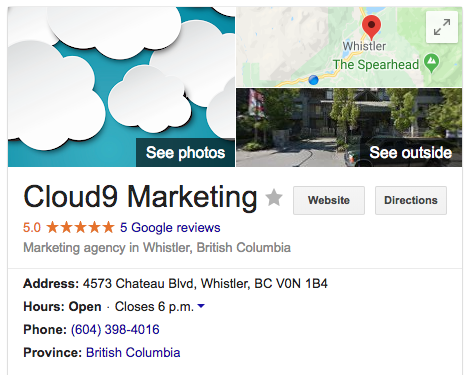
Local SEO Map Pack

What people see when they Google Cloud9 Marketing

#2 Keep your contact information consistent

It’s crucial that all your information is the same across online platforms. Not only does this make it easy for customers to find you, but also it shows you uphold a reliable business. NAP (your company’s name, address and phone number) is your digital thumbprint, and if this information fails to align across the different online profiles of your business, Google will recognise these inconsistent listings. The more times Google ‘sees’ your thumbprint on reputable websites, the more confident it becomes that it is displaying a trustworthy business in its search results.

#3 Build your online credibility

Even though this one takes time, having a solid catalogue of good reviews on your page is going to elevate your local credibility and improve your SEO ranking. A recent survey found that 84% of people trust online reviews as much as personal recommendations. Don’t be afraid to sincerely ask customers for reviews, and make it easy for them to do so by offering a multitude of potential review sites to use, such as Google+, Facebook and Yelp.

#4 Connect with other local Whistler businesses

If the Internet didn’t exist, you’d probably have to promote your business through regular networking, or by joining a Whistler business group, right? The truth is, you should still be doing the equivalent of this online. Start liaising with other local businesses and linking them on your site, and this will hopefully encourage them to return the favour. By engaging with respected companies you will show search engines that you are a trusted, reliable source.

#5 Write great content

If you keep producing quality, locally orientated content, then results will naturally follow. Keep your customers interested and engaged to increase their affinity with your brand. This can be via content promotions, polls, or just some interesting posts about what’s going on in Whistler next weekend. Maintaining steady blog posts and social media posts demonstrates your involvement in the local community, and can be a super effective way to increase your SEO.

Check out our tips on blogging to improve your SEO!

If you’re looking to get your Whistler business out there and feature on local search results, we can help. Cloud9 Marketing offers free SEO audits at no obligation.

seo-questions

Out of all of the services we offer at Cloud9 Marketing, SEO certainly has the most confusion surrounding it. Not only do many of our clients not completely understand what it encompasses, but they often have unrealistic expectations on how quickly it works. Properly implemented SEO will help a website rank well on search engines, with everybody’s goal being that coveted first page spot. Results for SEO aren’t overnight, and it’s important for businesses to realize that its an ongoing process. Here are the top questions we get from small businesses about SEO.

#1 What is SEO?

SEO stands for search engine optimization. In short, it’s how websites get found online with the common number one goal; to be displayed on the first page of the search engine results page. Keyword research, content marketing, back-linking and user experience are all aspects of SEO, but none will be completely effective without the other facets.

SEO is probably the most complicated aspect of online marketing. Involving so many layers and disciplines, some of which can only be properly employed by techy types with knowledge of web design and HTML.  With every business wanting more organic traffic, SEO is the way to get it. Of course you can pay to get traffic to your site, but organic Google rankings convey authority and trust, and SEO is how businesses get there.

#2 Should we pay for SEO in our business?

Although every online business could use SEO, not every business should allocate marketing budget to this area. In some cases, small businesses simply do not have the budget to compete with competitors for the top spots on search engines.

Businesses looking for immediate results will not benefit from SEO as SEO strategies take time (three months minimum for any impact). For small businesses operating in a competitive online space, who don’t have the budget to compete with online titans or who are seeking immediate results should opt for paid advertising, or other online marketing methods instead.

#3 What services does an SEO company provide?

Some SEO companies provide the gamut of SEO services while others focus on specific areas such as content creation, on-page optimization or link building. Having an audit done of your website is the first step to establishing your SEO needs.

Once you know what you’re dealing with, and understand the market in which you are competing, you can decide if and which SEO company can help you reach your goals. You may need someone who can cover every aspect of SEO from the technical to the content, to the links and authority; or you may simply need someone who can make some changes to the back-end of your website so it’s more search engine and user friendly.

#4 Can we do SEO ourselves?

There are some things businesses can do themselves to help optimize their website. Installing an SEO plugin such as Yoast can help ensure pages and posts are properly optimized for search engines using meta descriptions, title tags and focus key words. Blogging is an excellent way to increase organic page rank and can be done internally. By using popular key words for your business and industry you can generate more rankings for specific search terms. There are also a handful of free and cheap tools online that allow businesses to check their SEO status; MOZ.com, Ahrefs and Google Keyword planner are some excellent places to start.

#5 Why aren’t we getting instant results?

As a marketing agency that provides SEO services we are constantly abating client concerns about the lack of overnight results. It takes a minimum of three months for SEO results to flow in, and this can be even longer for websites that have had particularly poor performance or in ultra competitive market places. Patience with SEO is key. Understanding that SEO is a long game not an overnight miracle worker will help set realistic expectations when trying to improve your businesses SEO.

If you’re looking to rank on the first page of google and up your organic game on search engines, we can help. Cloud9 Marketing offers free SEO audits at no obligation.

Tag Archive for: SEO