
Looking for tips and advice on digital marketing, web development, branding or pretty much anything that helps your business to grow? Then check out the Cloud9 Marketing blog!

social media marketing matt astifan

This was an email I received from Matt Astifan about the Facebook for Brands Workshop we (Cloud9 Marketing) co-produced with him in March. Amazing results!

__________________

I love Whistler.

And that’s why when Virginia-Rae from Cloud9 Marketing asked me to host Facebook For Brands in Whistler I quickly agreed!

After the event, I was pleasantly surprised by the feedback I got at the workshop.

Not only did several people tell me it was the best Social Media Workshop they had ever attended. I had several emails from people showing me their new stats.

One person named Patrick from GetBud.net actually shocked me with his results.

He wrote:

“Hi Matt, I’m currently running 5 total ads and spent only $27.00 to generate all this interest…the numbers just keep going up and up! I’ve received a bunch of positive messages and no negative so far. Very encouraging for the start of my online venture! I’d be interested in knowing what you think…is this a normal response for a few $1.00 ads?”

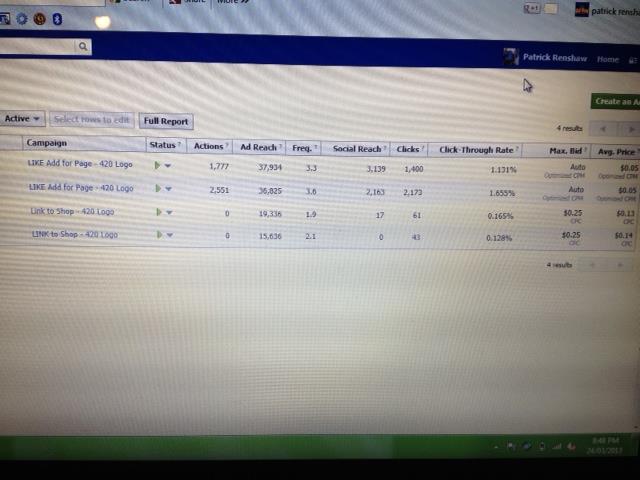
At first, I actually thought he was doing something wrong! I was afraid he was racking up a huge bill without knowing it! So, I offered him a free online consultation to review his Facebook Ads dashboard.

I helped someone get 11,000 Fans in 3 weeks - vquinnell@gmail.com - Gmail

The results: Gnarly.

Patrick was using the exact techniques I showed him in the Facebook For Brands Workshop and getting THOUSANDS of targeted fans for pennies!

He knew his fans’ demographics and what they were passionate about and designed Facebook Ads that engaged them.

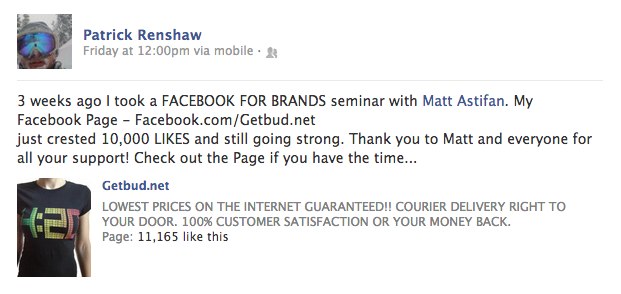
Here is what he wrote on his wall:

I helped someone get 11,000 Fans in 3 weeks - vquinnell@gmail.com - Gmail

Before attending the Facebook For Brands Workshop in Whistler on March 20th, 2013 Patrick had only 197 fans, today he has over 11,000!

Do you want to know exactly how he did it? Attend the Facebook for Brands Workshop in Vancouver on May 2nd and I’ll show you how. :)

It’s only been 24 hours and we’ve already sold 25% of the seats!

Get tickets here now –> http://www.webfriendly.ca/facebook-for-brands-workshop/

Best,

Matt

email marketing

Originally posted on Mashable: 5 Tactics to Grow Your Email List.

Back in January, many email marketers said increasing their lists was their top goal for 2013. Well, spring is here. Is your mailing list growing as fast as your flowers and lawn? If not, it’s time to execute a new plan.

Many marketers have email addresses only for 30% or less of their customer and prospect lists. They’re tempted to revert to their direct-mail experience and reach for a quick fix like email append (“e-append”) and list rental/purchase.

But in today’s engagement-based inbox placement world, this “quick fix” approach can give you more headaches than new sales.

If you seek quantity over quality in list growth, you’re practically inviting the ISPs either to block your entire opt-in mailing list or route everything to your recipients’ bulk folders, where they’ll languish in obscurity until the ISPs dump them automatically.

So, what should be in your email list growth plan? Below are five tried-and-true methods to ignite your email list growth, in a safe, permission-based way.

1. Make It Easy to Opt In on Your Website

Your customers and prospects must be able to find your opt-in form easily on your home page. This advice has been around for years, but today’s web designers apparently didn’t get the memo. They position Facebook and Twitter icons prominently but send you on a search-and-rescue mission to find the opt-in field.

Many websites undersell the email value proposition, using just a link saying “Sign Up for Email” relegated to the homepage footer. Worse, the email opt-in call-to-action isn’t even on the page. Make your forms stand out.

If you want to get more opt-ins, make the email invite more visible. Use a benefit-based call-to-action, and test an offer that you subsequently deliver in your welcome series.

2. Don’t Stop at Just One

Add more opt-in forms throughout your site and in various placements: above the fold (the horizontal halfway point on your website, like the fold in a newspaper), below the fold, in the right rail, in left-hand navigation and on a dynamic layer that displays according to visitors’ site activity.

Test these locations to see how many more opt-ins you can drive, each one alone and in combination with each other. One opt-in form on a page might drive X, while having two opt-in form placements on a page might drive 1.5X to 2X.

At the EEC Summit in 2012, Tommy Hilfiger reported that his company drives 2% of all site visitors to opt in by using a dynamic opt-in layer served to new site visitors on site entry.

3. Collect Emails at Your Stores

Ask your customers to opt in for email at your checkout counter or when requesting an email receipt. However, be sure you are collecting high-quality names.

You’ll have to develop a request procedure that helps you overcome two big pitfalls of point-of-sale requests: phony addresses, either provided by reluctant customers who can’t say no to the request or keyed in by sales associates who have to meet email quotas.

Mistakes, which happen when sales people misspell a written address, misunderstand a customer’s spoken address or omit a crucial detail like the “@” symbol.

Here are a few suggestions for collecting more and better addresses:

  • Let customers type in their email addresses on a POS touchpad or credit card terminal.
  • Give them an offer or benefit for signing up in-store.
  • Explain what they’ll be receiving.
  • Get explicit permission before adding the address.

4. Make It Mobile

Consumer adoption of mobile sites and apps makes mobile another important collection point for opt-in for both email and SMS text. The best mobile site home pages have two opt-in forms: one for email, one for SMS. Remember the constraints that mobile puts on viewing and data input.

Don’t ask users to fill out lots of form fields. Keep the form short and simple. You can collect more information later in your welcome series using progressive profiling.

5. Remember Your Social Networks

Give your Facebook followers a simple opt-in form page. Call out the benefits and differences between your social experience and your email communications.

Consider using social login, also known as social sign-in. This uses existing login information from social networks such as Facebook or Twitter to sign in to a website without having to create a separate login account specifically for your website.

You can also use this process to allow your site registrants to quickly and easily sign up to receive your marketing emails.

customer choice business

Here is a question I received through my Linkedin account in regards to customer choice – I thought the question was pretty interesting and touched on companies having to build on trust and goodwill to move forward, especially with the new Panda and Penguin releases in Google – so I decided to share it…

Hi Virginia,

I know you deal with a lot of people everyday and as a marketing professional I thought you may be able to give me some feedback. I have now been in a sales role with Paladin Security for just over 8 months. Cutting to the chase here is I wanted to know in your opinion what your feelings are to NOT having to lock into a 3 year contract for a business service such as cell phone service or as in my situation security alarm monitoring (for commercial or residential customers). Would not having to sign a fixed term contract be more attractive to you or people you know in general? Or would your answer be that it wouldn’t influence you in any way? Paladin just went with all services on a no fixed term contracts so I’m trying to see how I can position that in my conversations with decision makers. Thanks for any feedback. Greatly appreciated!
Warm regards,

Christine

————————–

Hi Christine,

Thanks for your message and congrats on your relatively new position!

Personally, I like the idea of a product not being available only on a fixed term. Especially as we are moving toward an era of genuine and transparent B2C interaction. With the importance of social media and socially influence search playing a much bigger role in SEO and other business ranking factors, the more trust you can build with your customers the better.

In my experience when you lock someone into a contract there is a mild feeling of mistrust – like “Why do they have to lock me into a contract? What don’t I know that I may not like down the road?”. Which does not build a feeling of goodwill and trust toward the business, and ultimately a negative impression – if only slightly. This may influence how they talk about your product OR if they talk about your product at all. Your customers want to feel in control about their choice to use your service and that by offering a flexible no-obligation option, you value that choice. I think if your marketing efforts can focus on humanizing your brand and developing a great customer satisfaction strategy, then your company’s move to no-fixed terms will be a success.  Good luck – thank you for your question!

With appreciation,

Virginia-Rae Choquette